
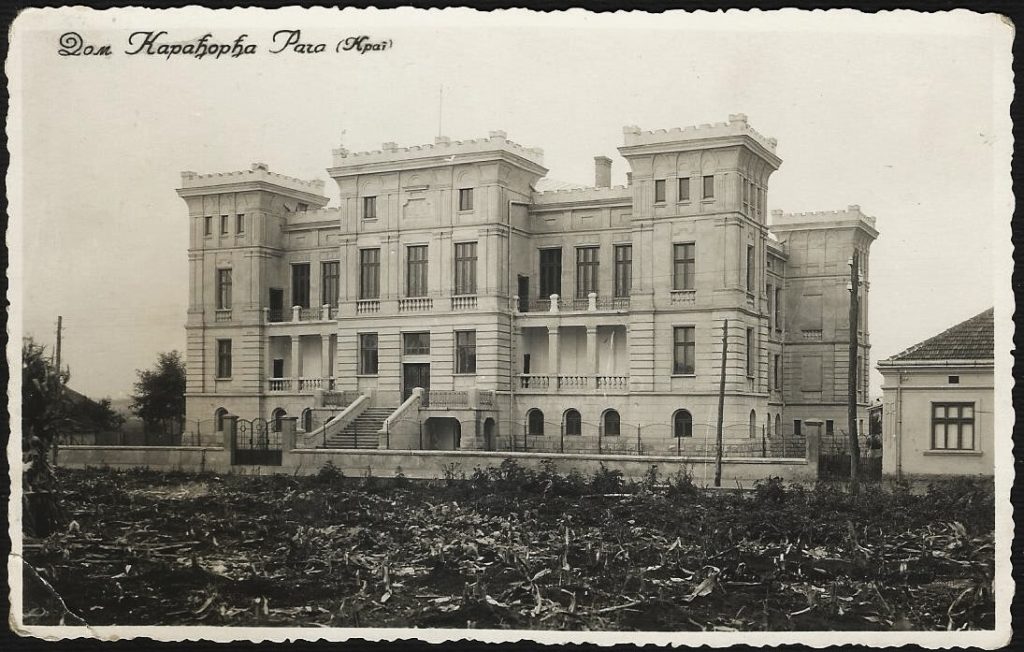
When Karađorđe’s Home was completed in 1933 in the Šumadija town of Rača, it was described as: “…this monumental building, the largest in Šumadija, is meant to serve as a humble tribute to the great deeds and merits of Vožd Karađorđe.”
Nearly a century has passed since then, yet Rača has not seen the rise of another structure that could rival it, nor has Šumadija as a whole fared much better in this regard. The building proudly bears the name of the man who first led the Serbs into their fight for liberation from the Ottomans, the same man we remember every Sretenje (Candlemas), when both the anniversary of the First Serbian Uprising and Serbia’s Statehood Day are commemorated.
On this occasion, we step away from the capital to introduce you to Rača’s very own palace, built just seven kilometers from Karađorđe’s birthplace.
And yes, as you might have guessed, the reasons for writing about this topic are quite personal—and not solely related to Karađorđe. Jovana, co-author of the blog Slike i prilike, grew up and lived until university in a family home just fifty meters from Karađorđe’s Home.
Additionally, this building was the subject of her first major research project during her undergraduate studies. In the following sections, she shares both her personal connection to this landmark and the history of its construction, along with its architectural characteristics, which remain a significant part of the architectural heritage of the Kingdom of Yugoslavia.
A Closer Look: Jovana on Karađorđe’s Home
I will always remember my first-year art history lectures, particularly when our professor would emphasize how architecture influences people, not just in their daily moods but in the very formation of their character. He would often say:
“Imagine living in Athens, seeing the white Pentelic marble of the Parthenon every day against the blue Mediterranean sky… Of course, that would have an effect on you!”
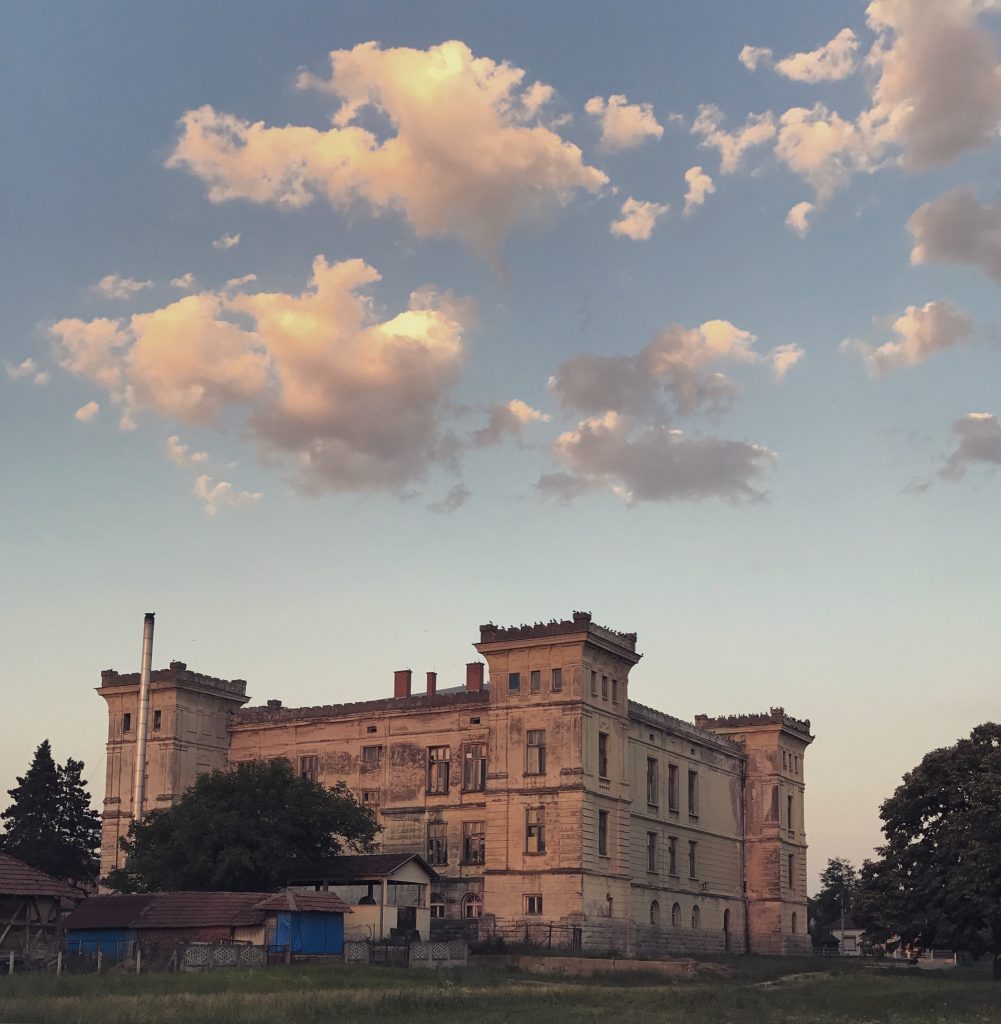
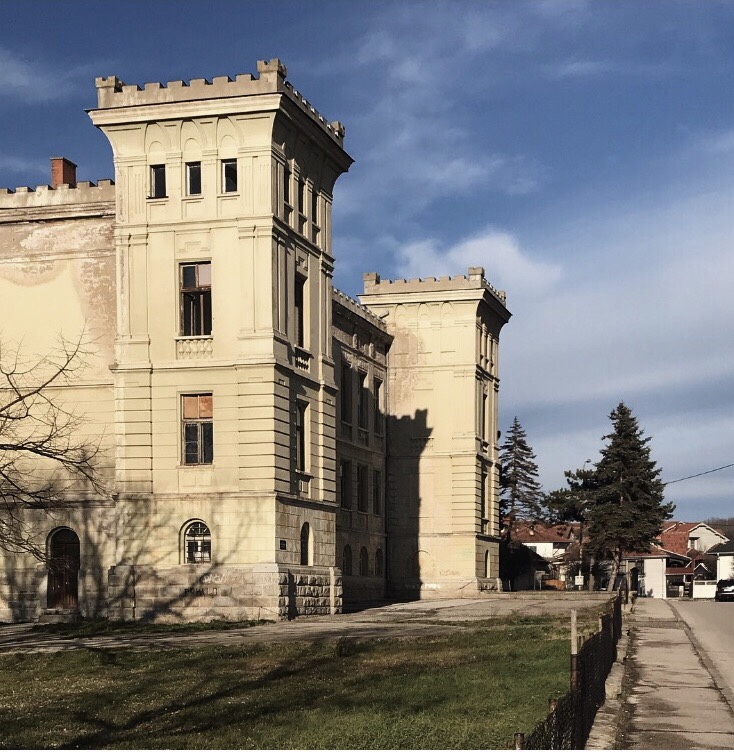
This made me wonder—what did I grow up seeing every day? What was my own architectural backdrop? And I must say, I found the answer satisfying—it may not have been the Parthenon, but the towers of Karađorđe’s Home against the Šumadija sky have always seemed majestic to me.
Even though it was always there, just within reach, I only entered the building a few times. For years, it housed the local elementary school, and as a child, I had no reason to go inside. I still vividly remember my excitement the first time I stepped in—it was during an election in the mid-1990s, and my parents took me to their polling station inside Karađorđe’s Home.
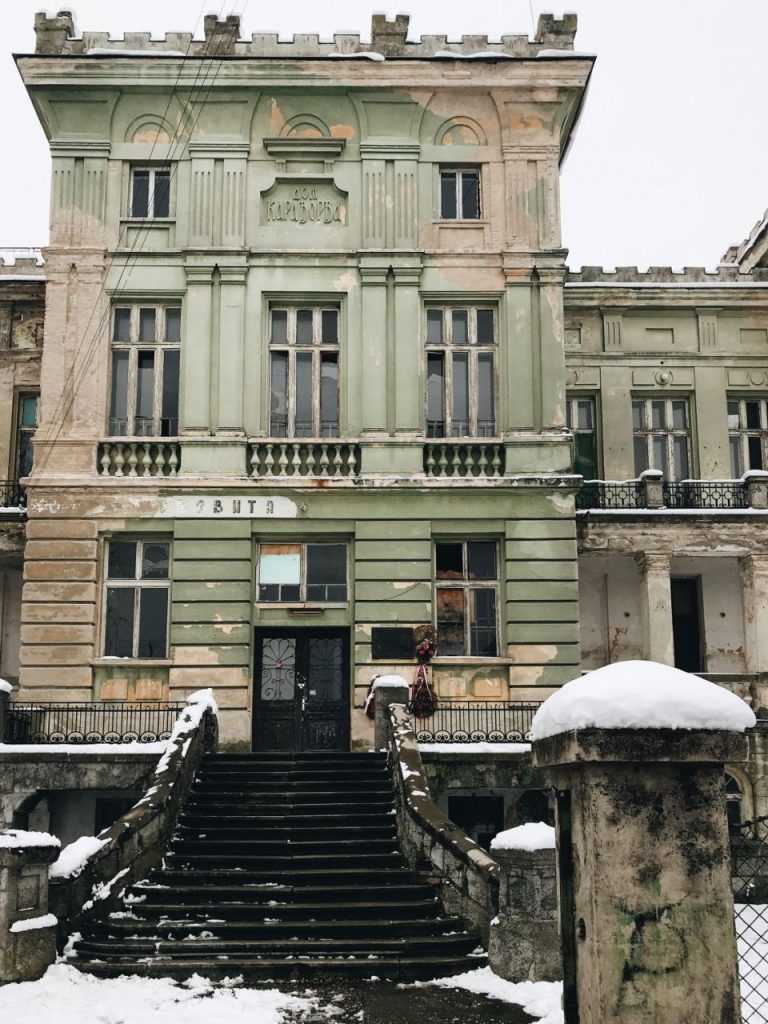
A year or two before I started school, the elementary school moved to a new building, leaving the Home vacant. However, in 1999, during the NATO bombing, it found a new purpose—housing refugees from Kosovo and Metohija. Originally built as a home for orphaned children after World War I, it once again fulfilled its role as a shelter, this time for dozens of families who spent the next fifteen years living there, albeit in extremely difficult conditions. Over time, this took a toll on the building, leading to its gradual deterioration.
Today, the Home stands abandoned, dark and awaiting a new purpose. At times, it resembles a haunted castle from a Gothic novel, yet I can assure you it still inspires awe in those seeing it for the first time—and even in those of us who have missed it after being away for too long. If you ask me, it remains dignified and imposing, like an aged man with time-worn lines on his face, yet one who refuses to give in.
At the end of this first part, I must admit—my professor was right when he spoke about the power of architecture. Especially in Rača, a small town with few notable architectural landmarks, but one constant presence—Karađorđe’s Home.
Even after thorough archival research, I still haven’t unraveled all the mysteries of its construction and architectural design, and perhaps that’s for the best. In a way, it will always remain the object of my gaze—both personal and academic.
But what I truly wanted to say has already been expressed far better by Meša Selimović:
“That is everything—to return. From one point on earth, to yearn, to set out, and to return again. Without that point of attachment, you would love neither it nor the world beyond it; you would have no place from which to begin, because you would belong nowhere. And yet, if you had only that place, you would also be nowhere—for then, you would not think of it, not yearn, not love. And that is not good. You must think, you must yearn, you must love…”
And when I return, I often translate that feeling into an image.
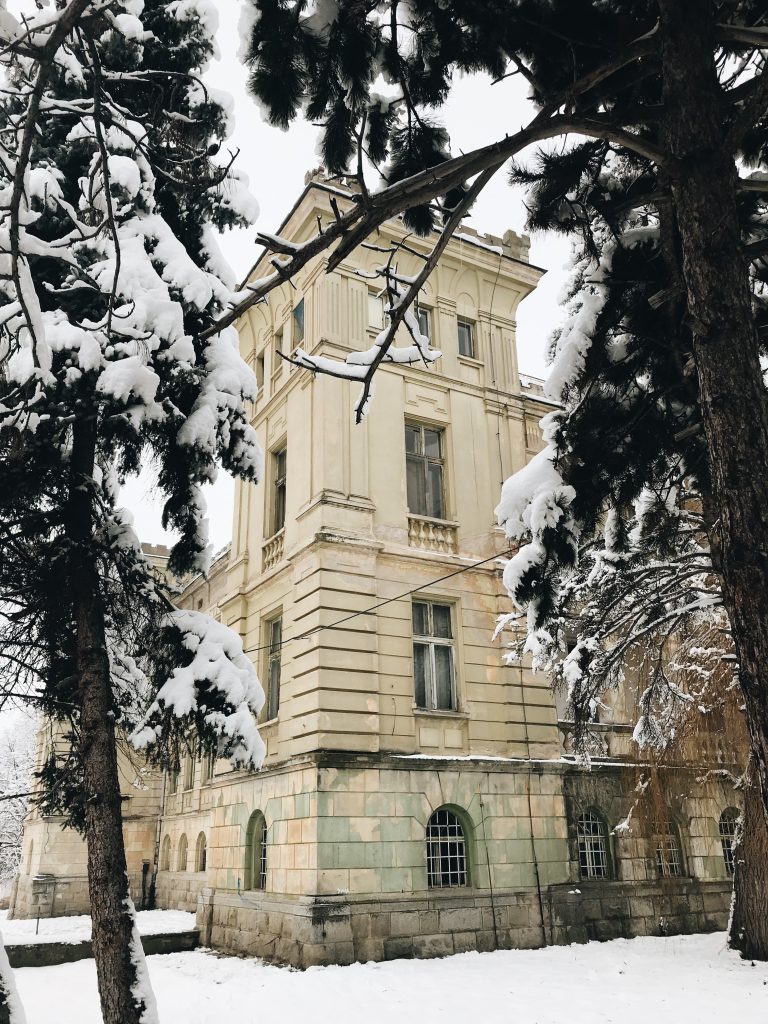
The idea of erecting a monument to Karađorđe in the region of his birthplace emerged shortly after the end of World War I. According to some accounts, the initial plan was to build a figurative monument in the village of Viševac. This idea was proposed by local teacher Jovan Jovanović – Kajafa, along with school supervisor and patriotic poet Dragoljub J. Filipović, and prominent Viševac resident Milan Jovanović.
However, Rača’s banker and industrialist Antonije Živanović proposed an alternative solution—instead of a statue, they would construct a memorial building that would serve as a cultural and educational center for the entire region. The decision was revised in favor of this proposal, and Rača was chosen as the location, primarily for practical reasons that would facilitate the construction process, but possibly also due to certain disagreements among the villagers of Viševac and the project’s initiators.
On Petrovdan (St. Peter’s Day) 1921, the aforementioned school supervisor, better known as Fića, presented the idea of a “home that would serve as an eternal monument to Karađorđe” to the people of Rača, who enthusiastically welcomed the proposal. Shortly afterward, a committee was formed to oversee the construction efforts.
The building process began before 1925, but progress was slow. To accelerate the work, parliament member Dragiša Matejić was asked to establish a central committee in Belgrade to raise additional funds for this monumental project.
Although the largest donation came from the royal couple, King Alexander and Queen Maria Karađorđević, more funding was still needed.
An article in the newspaper Pravda, published on December 9, 1933, covering the building’s consecration ceremony, stated that the construction of Karađorđe’s Home cost 3 million dinars.
By 1932, all construction work, including the interior decoration, was completed.
The official opening and consecration of the building took place on December 8, 1933, on the feast day of Saint Kliment of Ohrid, which was Karađorđe’s patron saint’s day.
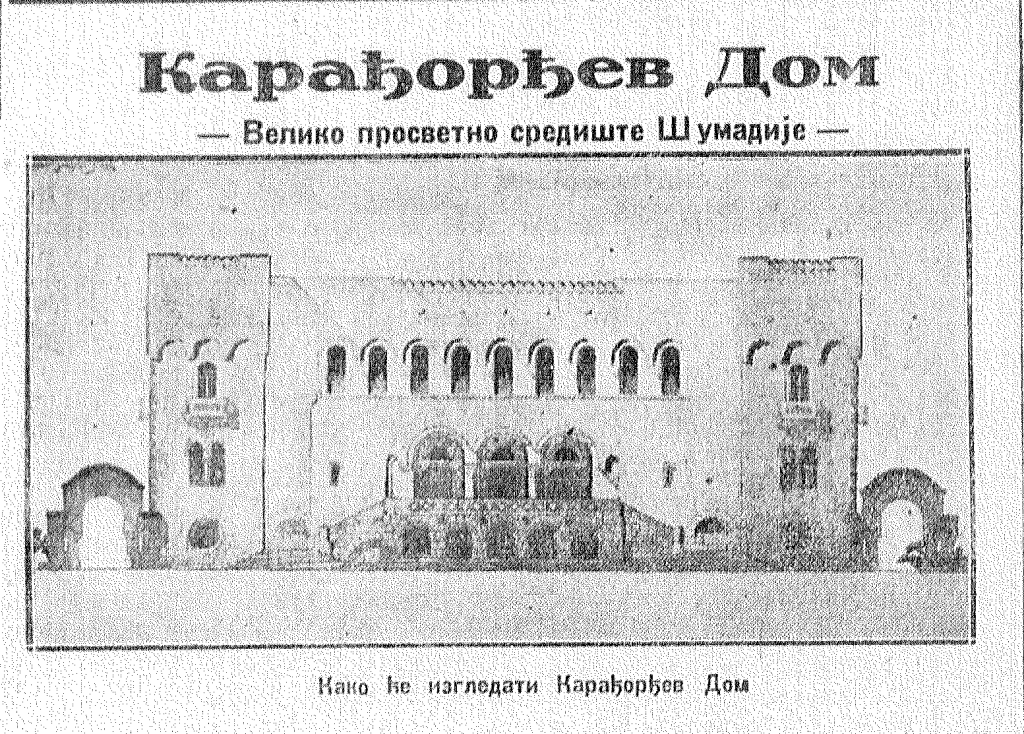
Due to the incomplete preservation of architectural and archival records related to the design process of Karađorđe’s Home, we still cannot definitively determine whose blueprint shaped the building as we see it today. However, certain hypotheses exist.
The first name mentioned in this context is the little-known architect Vlada Simić, whose project was accepted by the Construction Committee but apparently rejected by the Ministry of Construction.
A design proposal by the renowned architect Dragiša Brašovan, though ultimately not executed, is known from a 1927 article in Politika, which described the plan as:
“The building is designed in the Serbian-Byzantine style, featuring four towers, inspired by old Serbian palaces…”
The design that most closely resembles the completed structure is the one by Dušan Milević, preserved in the Institute for the Protection of Cultural Monuments in Kragujevac. However, even this plan does not fully match the existing building.
The involvement of multiple architects suggests a deliberate effort to align the building’s appearance with the ideological climate of the Kingdom of Yugoslavia, particularly after the January 6th Dictatorship, when the monarchy proclaimed the ideology of integral Yugoslavism.
The rejection of the Serbian-Byzantine style led to the adoption of a more neutral historicist form, which blended authentic local traditions with a universalist architectural approach.
In the case of Karađorđe’s Home, notable features include its four towers and central projection, topped with crenellated rooflines, a reinterpretation of medieval architectural elements. The entire structure evokes the image of a military fortress, likely alluding to Karađorđe’s town in Topola, reinforcing the notion that this was a monument to a “hero of the sword”—a man who, in the words of parliament member Milan Živanović,
“…raised the banner of freedom and laid the foundations of today’s great Yugoslavia.”
The framing of Karađorđe as the “father of the national and state freedom of the South Slavs” permeated both public discourse and historiography throughout the First Yugoslavia.
The invention of tradition was intended to overcome the deepening divisions among South Slavic nations, which grew more pronounced in the 1930s. This may explain the decision to abandon the Serbian-Byzantine style, even though the building stands in the heart of Šumadija, in favor of forms reminiscent of Vienna’s Arsenal or the Miramare Castle near Trieste.
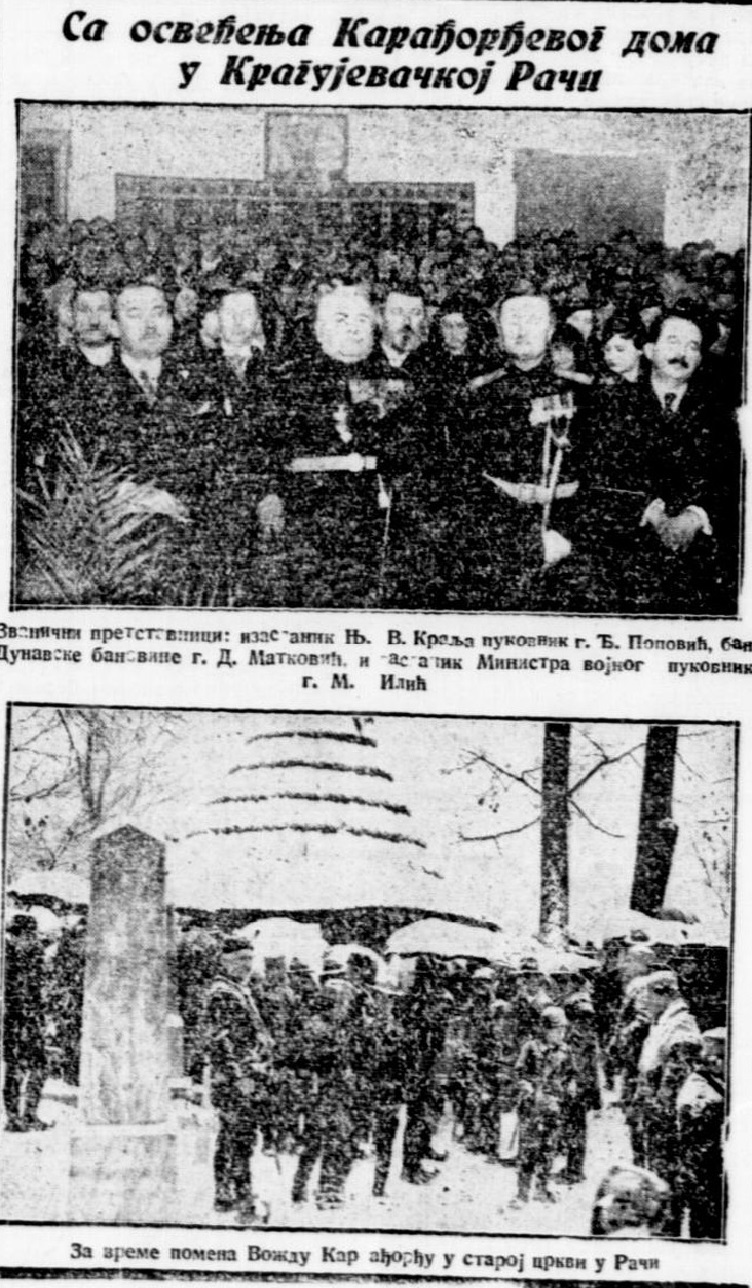
The final phase of the construction of Karađorđe’s Home culminated in a grand consecration ceremony and its official inauguration on Karađorđe’s feast day. By this time, the building was already in use, welcoming orphans from across the Danube Banovina, but the ceremony was deliberately scheduled for this date to elevate the cult of Karađorđe to its highest level.
The celebration began with a memorial service for the “immortal Vožd” at the old cemetery church in Rača, believed to be the place where Karađorđe was baptized (although this church was actually built ten years after his death, there are indications that an older wooden church once stood on the same site). Despite the existence of a new church in Rača at the time, choosing the older site for the service was a symbolic act, further reinforcing Karađorđe’s deep connection to this region.
The ceremony continued at Karađorđe’s Home, attended by numerous state officials, including the king’s envoy, the Ban of the Danube Banovina, and other high-ranking dignitaries. The event featured speeches celebrating the successful completion of the project, and the local choir “Filip Višnjić” enriched the gathering with a musical performance. In the evening, a festive celebration for the local people was held at the Hotel Europa.
The construction and consecration of Karađorđe’s Home serve as an example of how history evolves into myth, demonstrating the need to view the past through the lens of identity. Myth is a cultural construct that profoundly influences both the present and the future. By housing the orphans of those who perished in the wars between 1912 and 1918, Karađorđe’s Home functioned both as a monument to the founder of the ruling dynasty and as a tribute to all fallen soldiers and civilians of the Balkan Wars and World War I.
As a humanitarian and educational institution of the Kingdom of Yugoslavia, Karađorđe’s Home remained operational until September 1941, when World War II brought about new changes. During the war, the building was repurposed as a civilian school for war orphans. In 1945, it became a gymnasium, and in 1957, a school of agriculture. After the agricultural school was relocated to a new building in 1960, Karađorđe’s Home was repurposed once again, this time as an elementary school, which has since carried Karađorđe’s name, as it still does today.
Karađorđe’s Home stands as a reminder of who we once were—but also of who we can become again.


