
Today’s Republic Square, along with its equestrian monument, is undoubtedly the most famous meeting point in Belgrade. Phrases like “Meet me at the Square…” or “Wait for me by the horse…” are spoken by thousands of Belgraders every day. However, instead of focusing on the horse, this text will shed light on Prince Mihailo Obrenović and his role in the liberation of Belgrade, as well as in shaping its urban and symbolic identity.
In 1841, when Prince Mihailo moved the capital of the Principality of Serbia from Kragujevac to Belgrade, his efforts to develop the city on the banks of the Sava and Danube under the auspices of the Serbian nation began. The most significant event that secured his place in the pantheon of national heroes was the ceremonial handover of the keys to the Belgrade Fortress by the Ottoman governor Ali Riza Pasha. This event took place on Palm Sunday, April 6, 1867, when the prince triumphantly rode into the city on horseback—an image that would later influence the design of the monument on the square. In the days following Belgrade’s reintegration, the Ottoman army withdrew from Smederevo, Kladovo, Soko, Užice, and Šabac, and these cities were subsequently inscribed on the pedestal of the monument.
Beyond his skillful political and diplomatic maneuvers, which ensured that the Serbian flag was raised alongside the Ottoman one at the fortress, Prince Mihailo played a significant role in Serbia’s cultural development. Just a year after Belgrade was returned to Serbian rule, he initiated the construction of the National Theatre. However, he never had the chance to watch a single performance there—he was assassinated in Košutnjak in 1868, just two months later. His untimely death set in motion a series of commemorative acts meant to preserve the memory of the fallen prince.
The initial plan was to erect his monument at the site of the Great Market, where today’s Students’ Park is located, in front of Captain Miša’s Mansion. However, this space was symbolically associated with educational institutions, making it unsuitable for a state-monarchical monument. Instead, it was decided that the Theatre Square would be filled with the highest-ranking administrative buildings, while its ideological framework would be shaped through the monument dedicated to Prince Mihailo.
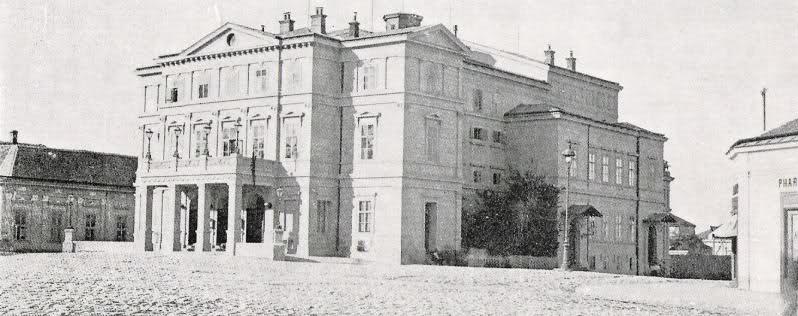
The state achievements of Miloš’s successor were seen as the first step toward Serbian independence and the revival of the golden age from the time of Emperor Dušan. Because of this, Mihailo was often compared to him, and it was precisely the equestrian depictions of Emperor Dušan that influenced the decision to portray the prince on horseback. In the process of nation-building, culture played a significant role alongside politics. Elevating the people’s ruler to a mythical level was not done solely through monumental artifacts but also through literature and theater. The National Theatre in Belgrade had a clear purpose in shaping the Serbian national identity. The building was inaugurated on October 30, 1869, with the first performed play being the historical drama Posthumous Glory of Prince Mihailo by Đorđe Maletić. This work not only glorified the prince but was also intended to inspire the people to complete what he had started—the liberation of Serbian lands from Ottoman rule.
The construction of the National Theatre was described as follows: With the restoration of the Serbian state, attention was immediately given to monuments of our old architecture… and now, at the people’s request, a temple has been built to meet the new national needs.
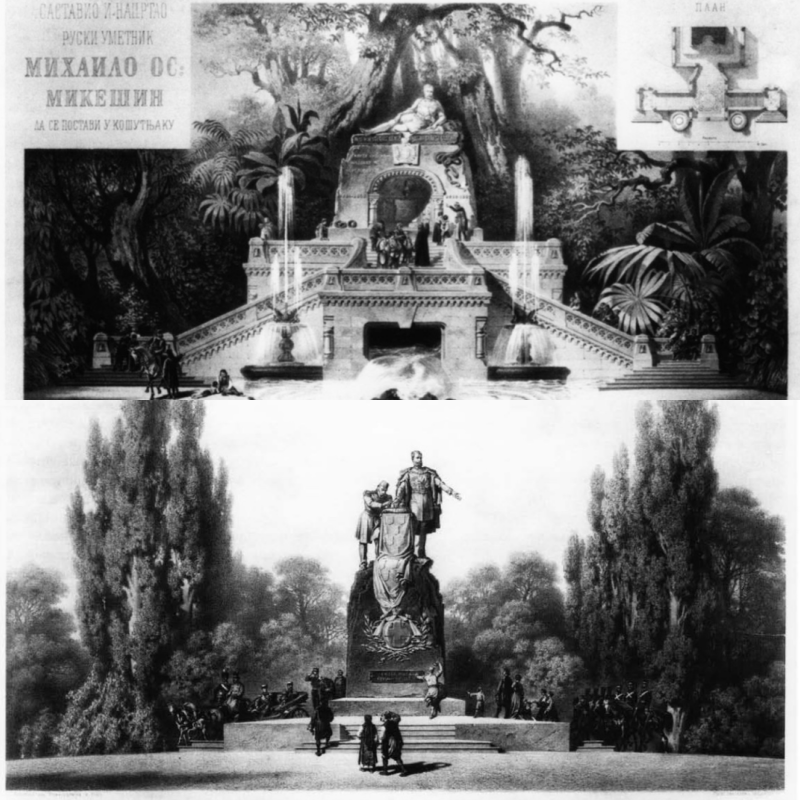
Both local and foreign artists were involved in designing the monument to Prince Mihailo on multiple occasions. One of the first was the Russian artist Mihail O. Mikeshin, who proposed two designs—one for the site of the prince’s assassination in Košutnjak and another for the Great Market Square. Although neither design was realized, these sketches remain significant in tracing the development of the idea of the ruler as a hero in the context of Mihailo’s tragic death. Mikeshin’s designs exuded the romantic spirit characteristic of his monuments erected in Russia.
After various changes in leadership in the young Principality of Serbia and shifts within the monument committee, an international public competition determined that the creation of the monument would be entrusted to the Florentine sculptor Enrico Pazzi. In his artistic milieu, Pazzi was known for his verismo—an emphasis on precise and realistic depictions of figures. For this reason, in 1872, he sent a bust—now housed in the National Theatre—for verification of the accuracy of Prince Mihailo’s likeness before proceeding with the bronze sculpture. However, the advisory body in Belgrade insisted that the prince be modeled in accordance with idealistic realism. One of the key figures in shaping the monument’s conceptual meaning was the highly educated Mihailo Valtrović, who believed that the purpose of a public monument was not to realistically portray a historical figure but to embody an idea. As he put it:
A work of art should be a complete expression of an idea.
Work on the monument’s model began in 1874, when Pazzi spent nearly a year in Belgrade. However, its completion was delayed by the Serbian-Ottoman wars, which finally ended in 1878, when the Principality of Serbia gained formal independence. The monument’s final stages were completed after these events. The bronze equestrian statue and pedestal were cast in Munich in 1879 and placed on a marble base. Upon its installation, the monument was truly monumental in scale: it stood 11 meters high and 8.45 meters long, with the equestrian figure itself reaching 5 meters. The pedestal was later slightly modified, but its dimensions have remained largely unchanged.
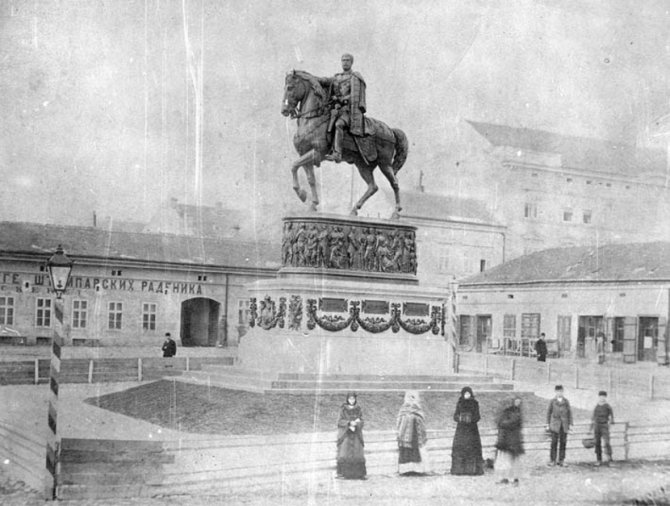
The square where the Monument to Prince Mihailo stands only took on its present form after the expulsion of the Ottomans from Belgrade. Until 1866, the site was occupied by the Stambol Gate, which marked the beginning of the famous Constantinople Road, connecting Belgrade to Istanbul. This gate was built in the early decades of the 18th century when, following the Austro-Turkish wars, the Habsburgs took control of the former Serbian capital. Behind the monument, before the construction of the Mortgage Bank—today’s National Museum building—there was a one-story structure with shops, while diagonally across from it stood the Dardanel café.
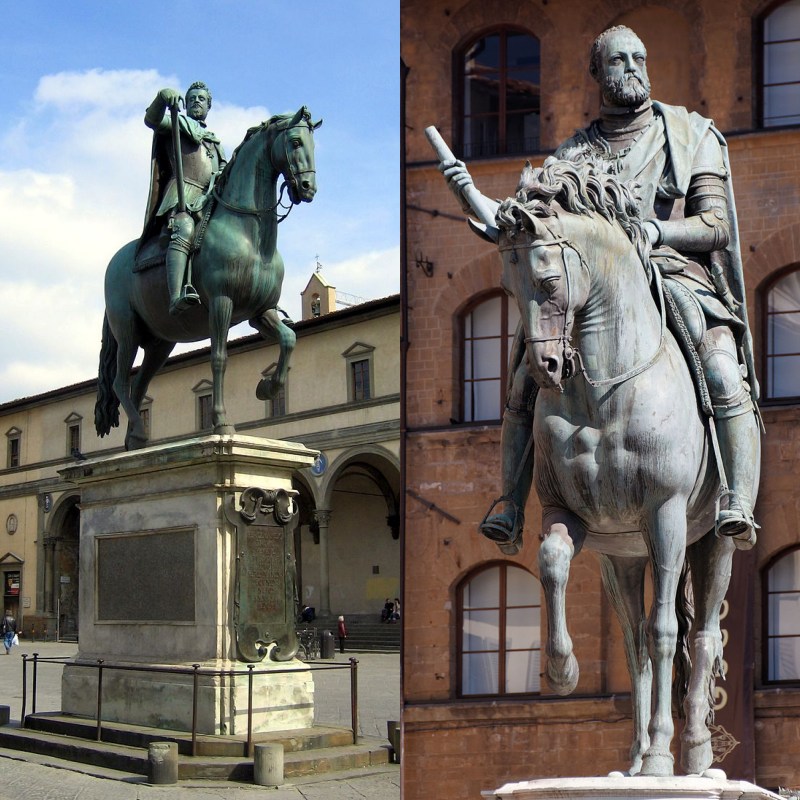
The entire urban layout of Belgrade followed a north-south orientation, and the prince’s monument was aligned accordingly. The depiction of Prince Mihailo on horseback, along with the reliefs on the pedestal, encapsulated the ideological message that the monument was meant to convey. In designing the monument, Pazzi drew inspiration from examples available to him—specifically, two equestrian statues of the Medici family in Florence. The static, ceremonial stance in which Mihailo is depicted portrays him as a monarch-statesman and diplomat rather than a warrior. In his left hand, he holds the reins—a well-known gesture of royal ideology symbolizing control and governance. The movement of his outstretched right hand, signifying the ruler’s benevolence, was derived from Roman tradition, specifically from the famous equestrian statue of Marcus Aurelius in Rome. This statue was the only one of its kind to survive the Middle Ages, as it was mistakenly believed to depict Emperor Constantine the Great.
Beyond the codified gestures of Roman rhetoric, the raised hand of the Serbian prince and the direction in which he points carried additional meanings. At the time, the Serbian press emphasized that Mihailo was pointing south, which is true given the monument’s orientation. The idea of a path toward the liberation of the medieval Serbian lands was deeply embedded in national ideology during the second half of the 19th century. This notion was explicitly stated in Serbian Illustrated Newspapers, which described the monument by noting that Prince Mihailo gestures southward, indicating the direction in which the Serbian people’s main aspirations should be directed.
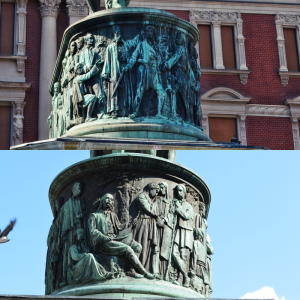
This idea is further reinforced by the reliefs on the pedestal beneath the equestrian statue. The front and rear reliefs draw from the dynastic mythology that emphasized the antiquity of the Serbian nation and its revival under the Obrenović dynasty. On the front, southern side, the relief depicts the moment when Prince Miloš arrives in Takovo and utters the famous words: “Here I am; here is war with the Turks.” Beside him stands Priest Melentije, blessing the banner with a cross, while to the side, the gathered people pledge their allegiance to the uprising. The rear relief features The Serbian Guslar, celebrating epic folk poetry, with the blind singer becoming a national symbol that remained deeply rooted in Serbian culture.
The first two reliefs emphasize dynastic and state continuity, as well as the idea of a liberation war—one that began with Prince Miloš and was passed down to his successors, Prince Mihailo and later King Milan. The two side reliefs glorify Prince Mihailo, presenting imagined dialogues between the ruler and his people. The first depicts a conversation during his lifetime, while the second takes place after his tragic assassination.
On the eastern side, The National Deputation before Prince Mihailo portrays the prince with his entourage, facing a representative of the people dressed in traditional attire from the yet-unliberated Serbian territories. This representative holds an unfurled scroll in his right hand, while his left hand rests on his chest—a gesture that can be interpreted as a plea for the prince to free the lands still under Ottoman rule.
On the western side, the relief Serbs Swearing an Oath at the Grave of Prince Mihailo centers around an ancient-style sarcophagus, inscribed in French with Michel III, Prince de Serbie. In front of it stand the Metropolitan of Belgrade and a mother with a child—symbolic figures of faith and the state. Around them, Serbs dressed in various traditional costumes raise their hands in oath, symbolizing their pledge to continue the struggle for liberation.
The grand unveiling of the monument to Prince Mihailo Obrenović on Belgrade’s Theatre Square marked the final stage in shaping one of the most powerful Serbian political myths of the 19th century—the liberation of Serbs from the Ottomans, led by the Obrenović dynasty.
With the change of ruling dynasties at the beginning of the 20th century, the monument lost its ideological significance. However, its recognition within the public space of Belgrade remained untouched through the years—the only problem being that everyone knows about the horse, but not the prince. Next time you arrange to meet someone at this iconic location, take a moment to carefully observe the artistic details of the monument and reflect on Prince Mihailo’s contributions to making Belgrade the city we know today.


