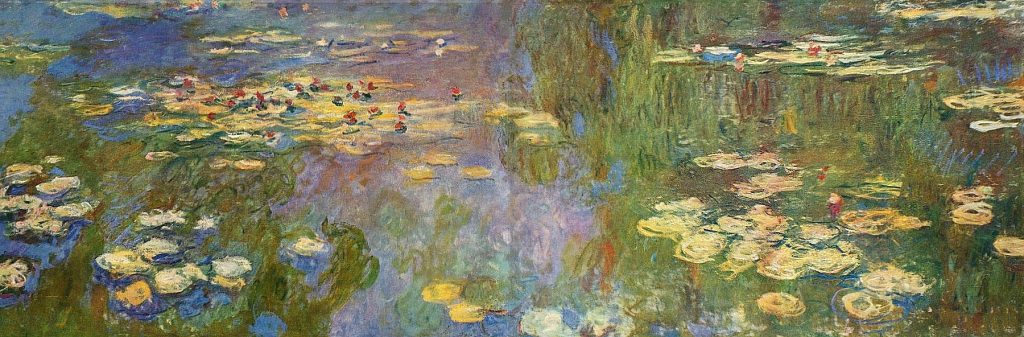
I visited Giverny twice—once in the fall of 2016 and again in early spring of 2019. Unfortunately, neither in October nor in April were Monet’s garden and Japanese water garden at their peak, but I have no complaints—being there always feels surreal. Giverny is located about an hour’s drive northwest of Paris, in Normandy, and the Monet Foundation welcomes over half a million visitors each year. When I say “each year,” I mean within the seven months it is open—from April to October. In addition to the painter’s house and gardens, Giverny is also home to the Museum of Impressionism, which is well worth a visit.
Monet, the man who pioneered a new artistic movement, spent 43 years of his life in this Norman village. Here, until the very end of his life, he worked tirelessly on the “scenery” for his paintings. He meticulously observed the shifting light throughout the day, the atmospheric effects, and the changing seasons, leaving behind a legacy of over 1,300 canvases—some of which influenced the birth of other modern art movements. So, let’s take a walk together through Monet’s microcosm in Giverny.
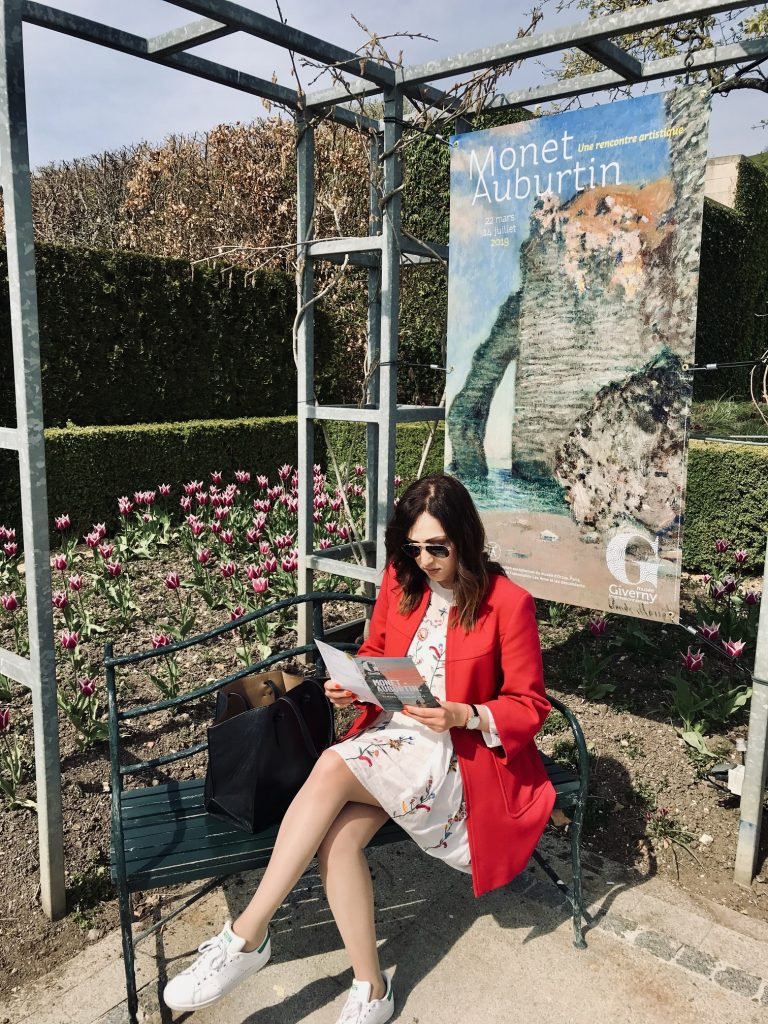
In front of the Museum of Impressionism in Giverny, April 2019.
“Color is my daylong obsession, joy, and torment” Claude Monet
The artist’s connection to Normandy did not begin in 1883 when he moved to Giverny—it started much earlier. Although born in Paris in 1840, Monet moved with his family to Le Havre on the English Channel in 1845, where he received his first painting lessons. At the age of 11, he enrolled in art school, and the guidance he received from the painter Eugène Boudin remained a lasting influence on his work.
One of the defining features of Impressionism—plein air painting, or simply painting outdoors—was something Monet adopted from Boudin and incorporated into nearly all of his works. Boudin painted the coastline and rural landscapes of Normandy, earning the nickname “King of the Sky” in Impressionist circles for his atmospheric seascapes. The crisp northern light, turbulent sea, and distinctive rocky terrain of northern Normandy became recurring elements in many of Monet’s canvases.
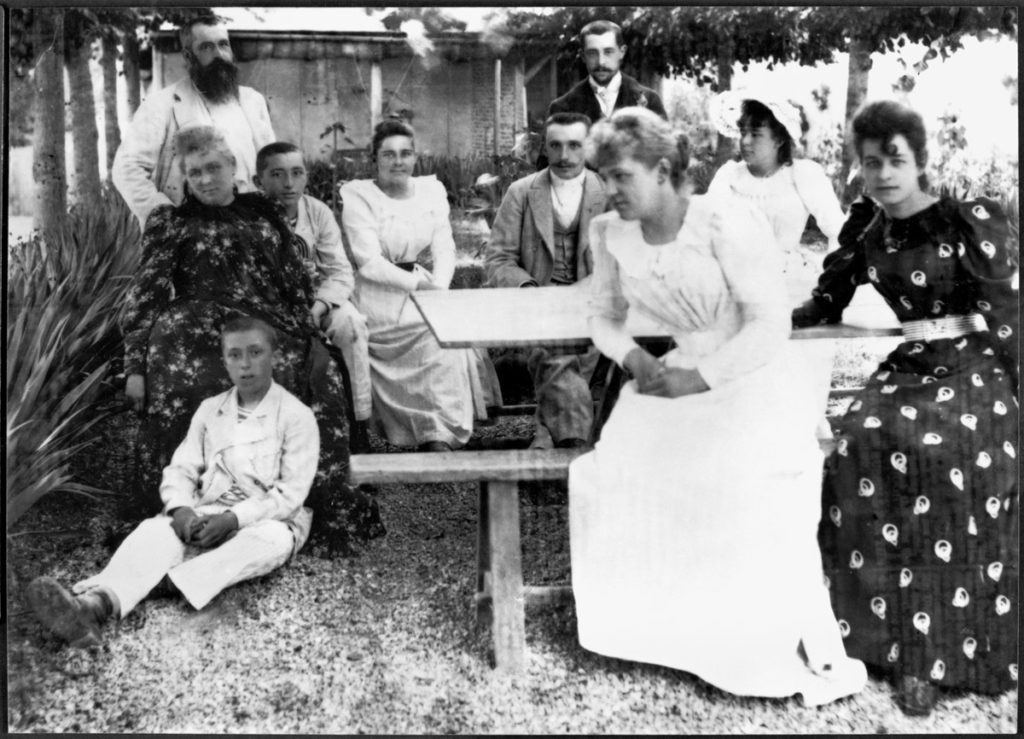
Painter Claude Monet with his family
Monet in Giverny
Shortly after arriving in Giverny in May 1883, Monet rented a house with a garden and an orchard, where he would remain for the next 40 years with his large family. Seven years later, in 1890, his financial situation stabilized, allowing him to finally purchase the house and estate. Without delay, he set to work on renovating his new home and designing the garden, personally overseeing all the work and giving precise instructions.
Monet’s deep understanding of color and his passion for it were reflected in his home. The distinctive pink facade was painted according to his instructions, with green shutters providing a striking contrast to the rosy walls. On the ground floor, his studio remains, though it no longer houses his original works, as they are now scattered across museums worldwide. However, faithful reproductions evoke the appearance of the studio as it was during the painter’s lifetime.
The entire interior of the house is filled with Japanese prints and other artworks that inspired not only Monet but the entire Impressionist movement. Unlike his own paintings, which have been dispersed, these pieces have been carefully preserved in their original form.
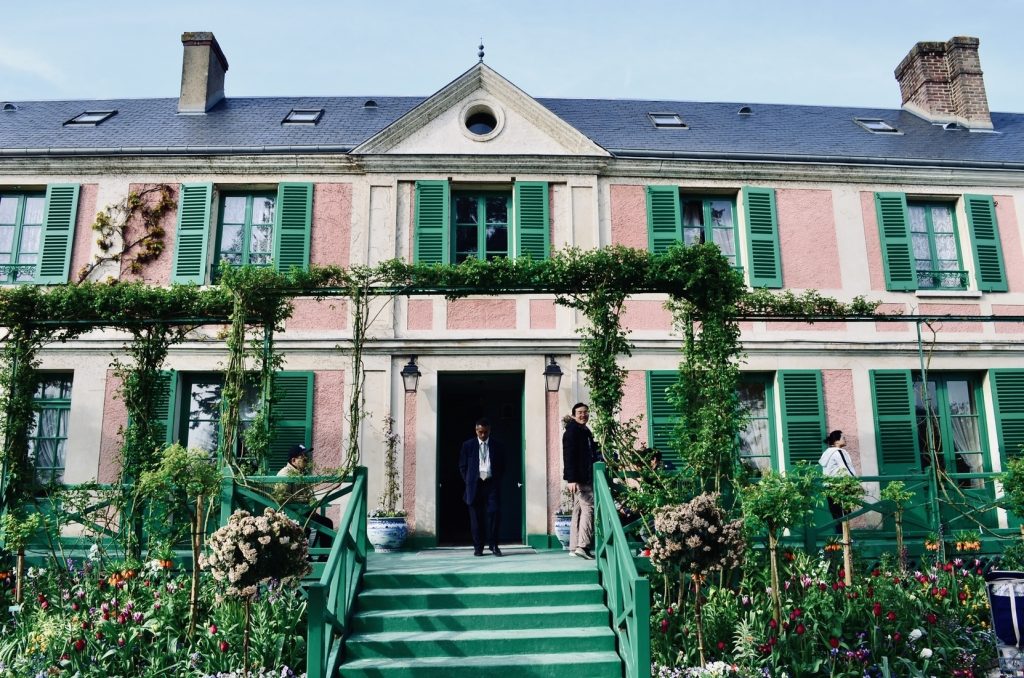
The Painter’s House, April 2019.
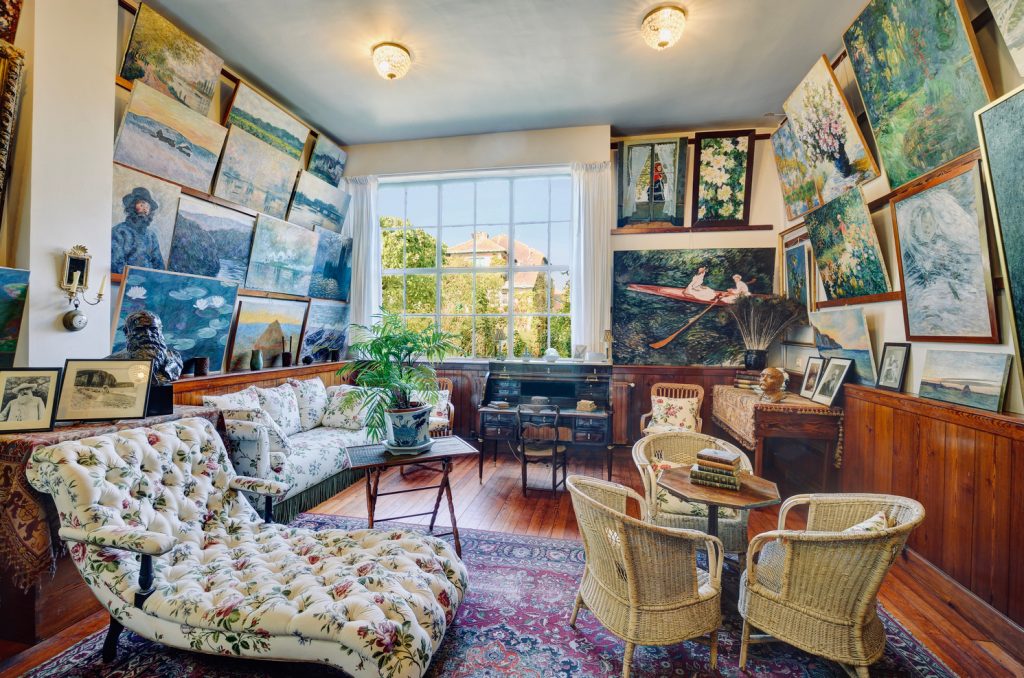
Painter’s studio – later salon, photo courtesy of Boris Petrovski
On the ground floor, alongside the artist’s studio—which later also served as a salon—are two of the most vibrantly decorated rooms in the house: the dining room and the kitchen. The dining room is bathed in a warm, intense yellow hue—everything from the walls to the cupboards, table, chairs, and even the fireplace is yellow! From here, a beautiful view of the garden opens up, while the walls are adorned with Japanese woodblock prints.
Adjacent to the dining room is the kitchen, where blue dominates the space. A large portion of the walls is covered in blue-and-white ornamental tiles, from which authentic copper cookware hangs. Monet lived in this house not only with his second wife, Alice, but also with their blended family of eight children—her six from a previous marriage and his two.
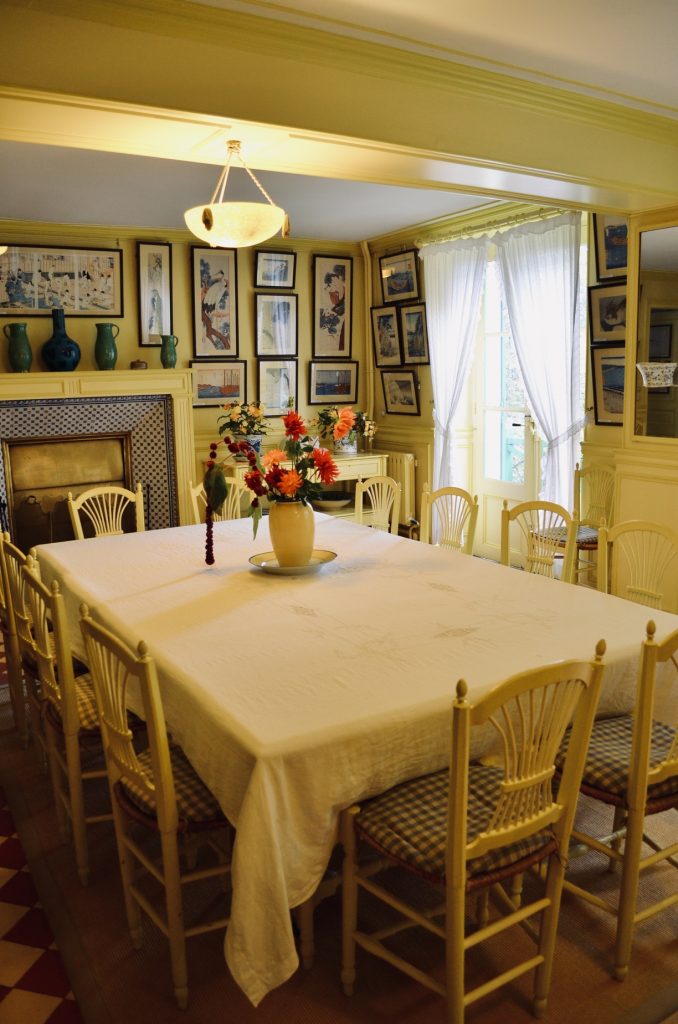
Dining room, April 2019.
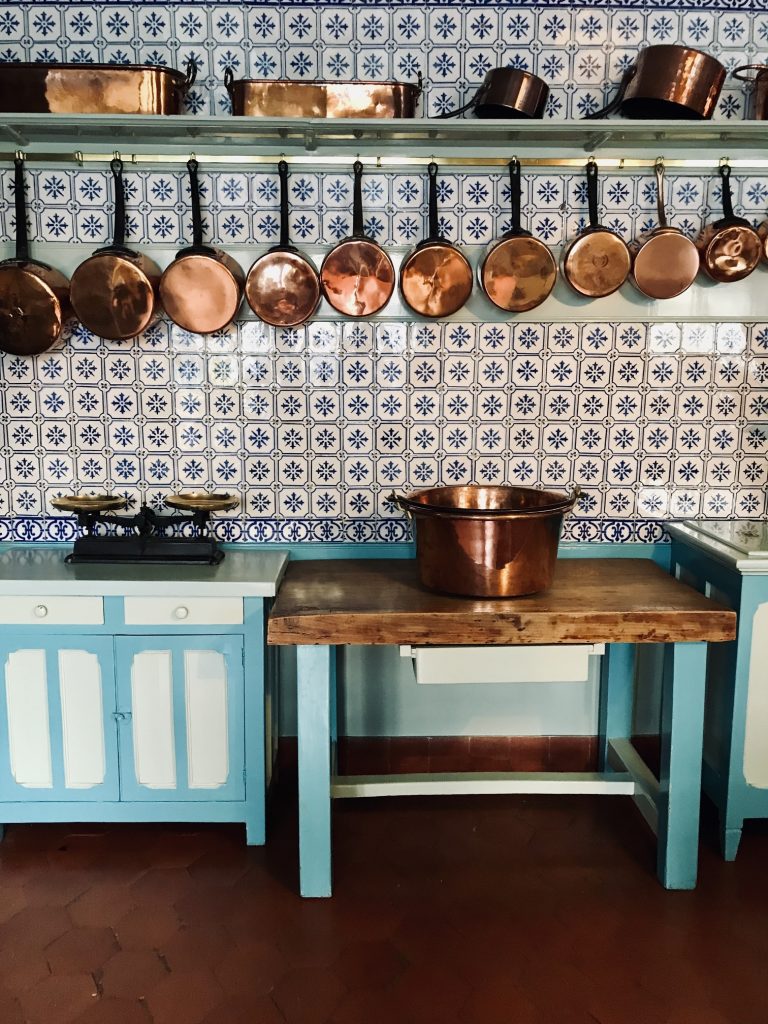
Kitchen, April 2019.
The upper floor houses the bedrooms. From the window of Monet’s room, there is a breathtaking view of the garden, while the walls are decorated with works by his fellow painters—Renoir, Caillebotte, and Cézanne. A well-known anecdote recounts how Monet, in moments of artistic fervor, would turn these paintings to face the wall so they wouldn’t distract him. Naturally, these are now replicas, as the originals are in museums worldwide, but even the copies help recreate the atmosphere of the painter’s private space.
Next to Monet’s bedroom is the room of his wife, also decorated in cheerful colors. However, the most charming room on the upper floor is undoubtedly that of Blanche, who was both Monet’s stepdaughter and daughter-in-law. Blanche was Alice’s daughter, and she later married Monet’s son Jean. She was the only one among their children who showed a serious interest in art, painting in the style of her stepfather and father-in-law. After Jean’s death in 1914, Blanche returned to Giverny to care for the aging artist, remaining by his side in his final years.
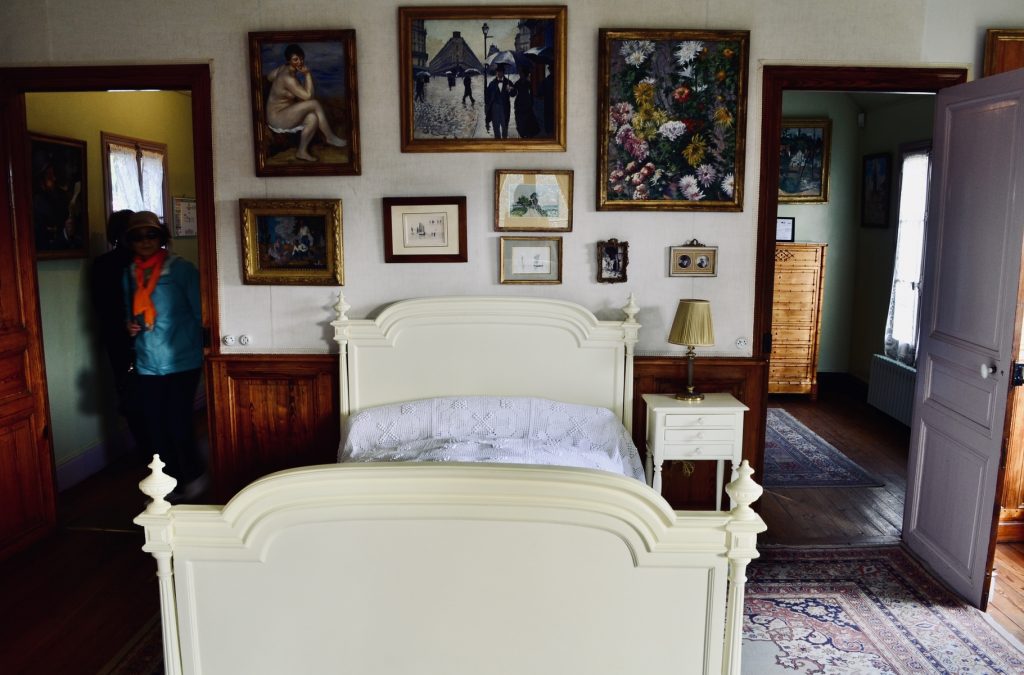
Artist’s bedroom, April 2019.
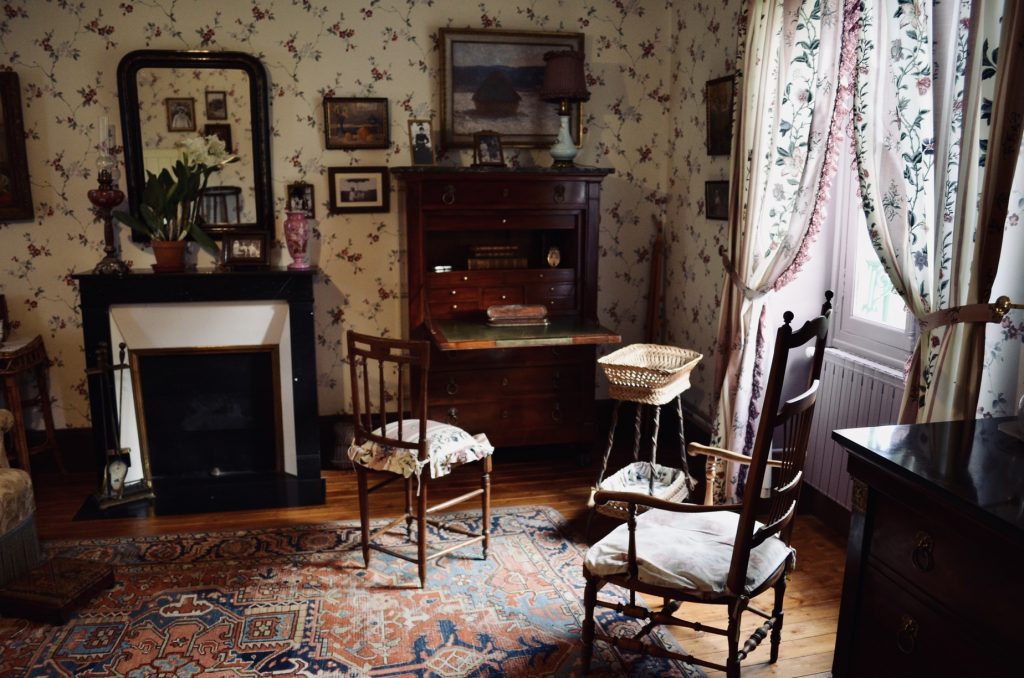
Blanche’s bedroom, October 2016.
Claude Monet passed away in Giverny in 1926, at the age of 86, and was buried near his home in the courtyard of the local church. Blanche remained on the estate in Giverny until her death in 1947. After the passing of Monet’s younger son, Michel, in 1966, the artist’s estate was transferred to the state and eventually transformed into a museum complex.
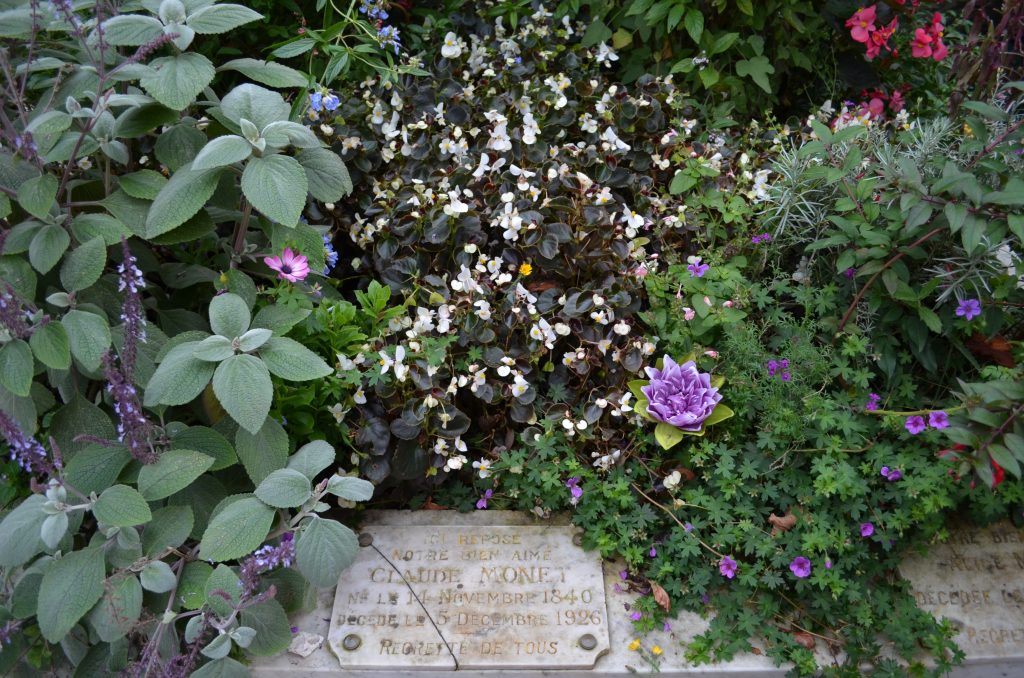
Claude Monet’s grave, October 2016.
“I perhaps owe having become a painter to flowers.” Claude Monet
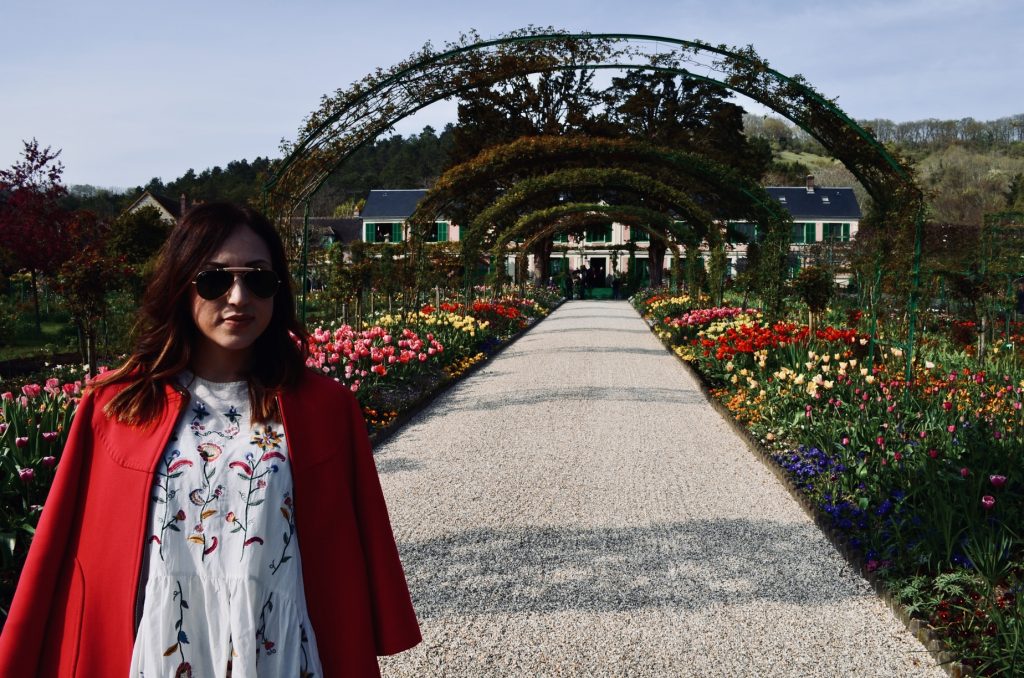
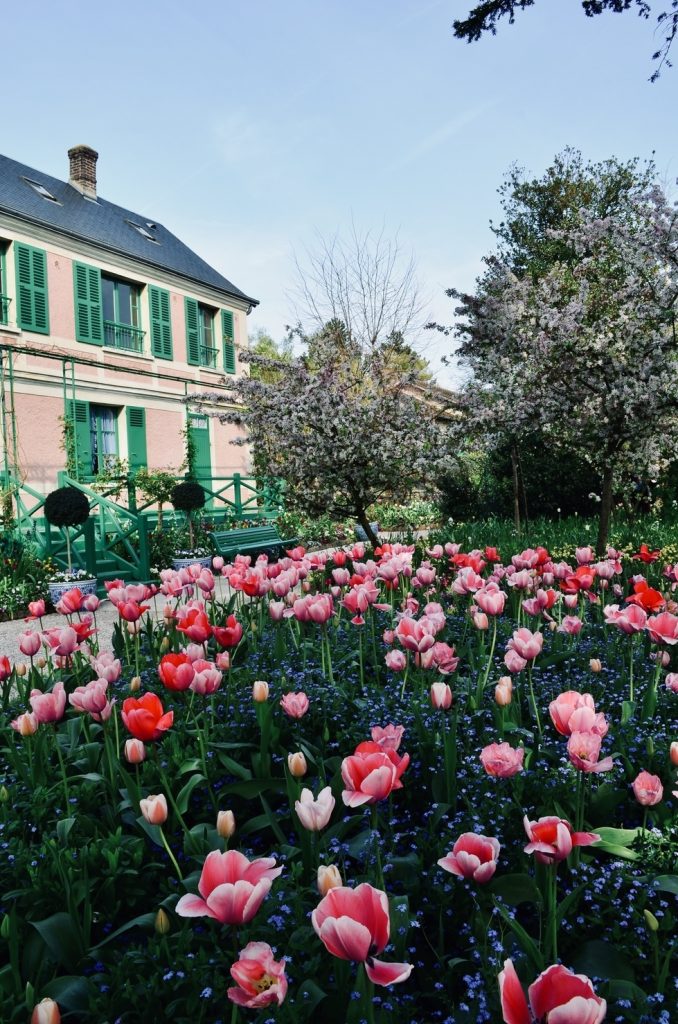
In the Enclosed Garden of Normandy, April 2019.
The Clos Normand and the Water Garden
In addition to the orchard and vegetable garden, the greatest care was devoted to a flower garden that even had its own name—Clos Normand (The Enclosed Garden of Normandy). This space received the most meticulous attention. A central pathway is framed by metal arches, originally placed by Monet himself, while on either side, colorful “carpets” of flowers spread out, featuring daffodils, tulips, irises, oriental poppies, peonies, and roses.
Monet’s passion for gardening was just as deep as his love for painting. He once declared, “My garden is my most beautiful masterpiece.” Indeed, he designed his garden with his artistic vision in mind, carefully selecting and arranging plant species, colors, and shapes in a way that reflected his painterly sensibilities.
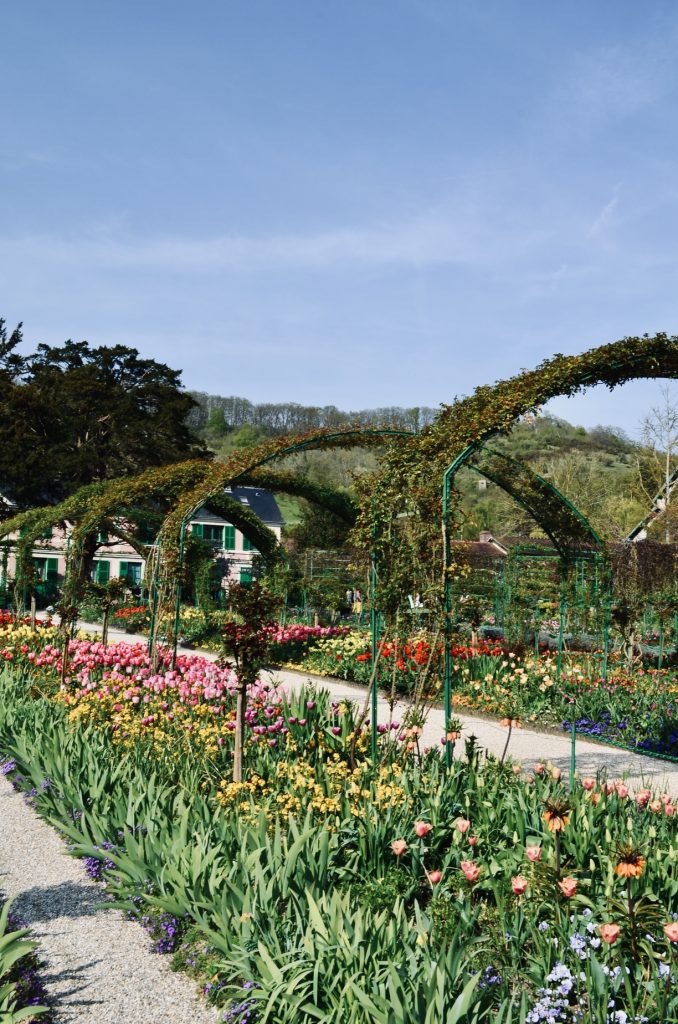
Fascinated by the interplay of light and the reflection of the sky and clouds on water, Monet redirected the course of a local river in 1893, creating a pond that would become his Jardin d’eau (Water Garden), as he called it. Extending from the central pathway of Clos Normand, the artist built a Japanese bridge, undoubtedly inspired by the Japanese prints adorning the walls of his home. Unlike traditional Japanese bridges, which were typically painted red, Monet chose to paint his in green to blend harmoniously with the surrounding landscape.
To capture the essence of an authentic Japanese garden, he planted bamboo, ginkgo biloba, maple trees, and Japanese peonies. However, the most iconic addition was the famous water lilies, which would later be immortalized on the walls of the world’s most prestigious museums. The gentle rustling of the wind through the bamboo adds to the mystical ambiance of this Eastern-inspired retreat.
Monet employed several professional gardeners to maintain his beloved sanctuary, ensuring that every fallen leaf was removed from the pond so as not to disrupt the perfection of the water lilies. In his later years, these floating flowers became his most frequent subject, with some of his paintings verging on abstraction—pushing the boundaries of Impressionism and paving the way for modern art.
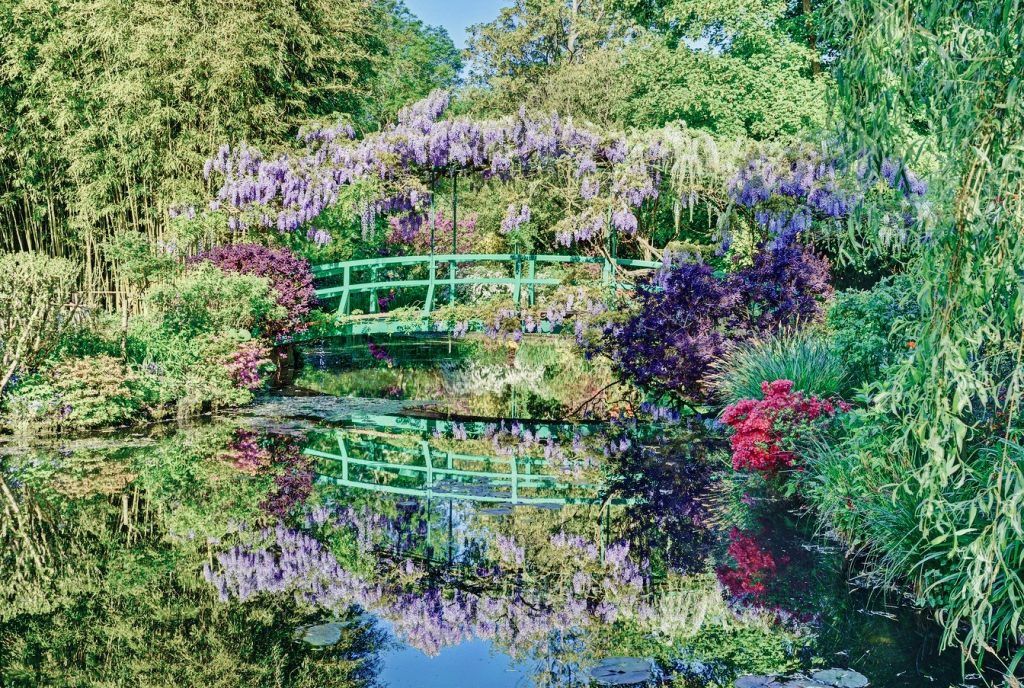
View of the lake and Japanese bridge, photo courtesy of Boris Petrovski
Water Lilies – Nature or Abstraction?
Nowhere is the spirit of the gardener-painter more evident than in Monet’s Water Lilies series. He paved the way for abstraction by allowing the subject to take a secondary role, placing the painting itself at the forefront. For Monet, the canvas had its own existence—it was an autonomous work of art.
In his final paintings, he dissolved form into a mist of vibrant colors, erasing the horizon and saturating the canvas with luminous brushstrokes. The influence of his work can be seen in Fauvism, Expressionism, the abstract art of Wassily Kandinsky, and even the Abstract Expressionism of Jackson Pollock.
And to conclude with his own words:
“I have always hated theories… My only merit is that I have painted in the direct presence of nature.” – Claude Monet
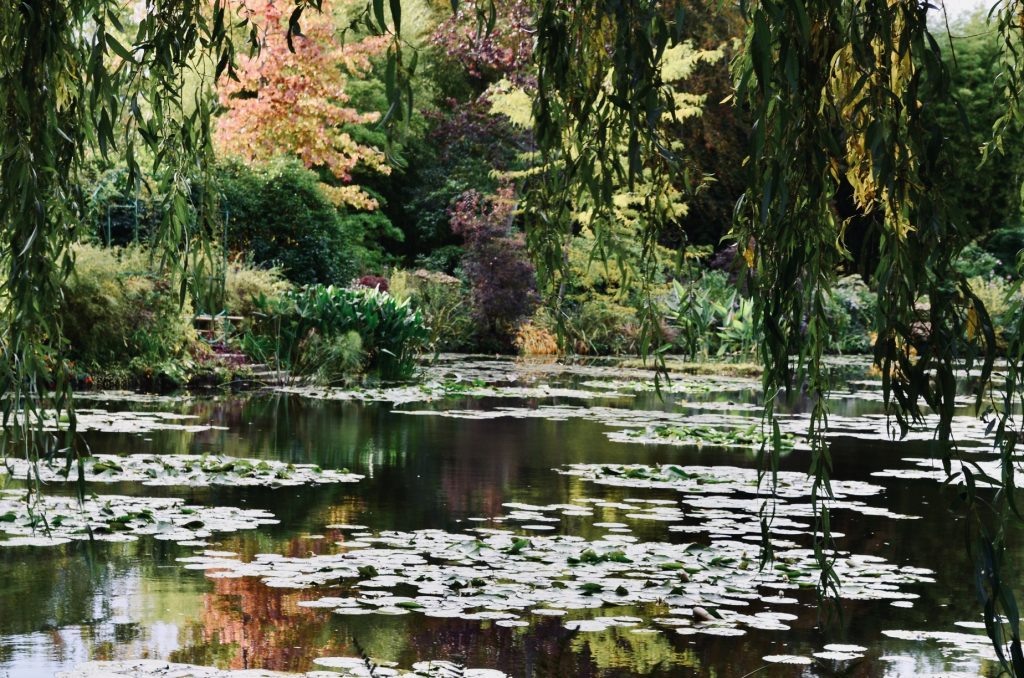
Water Garden, October 2016.